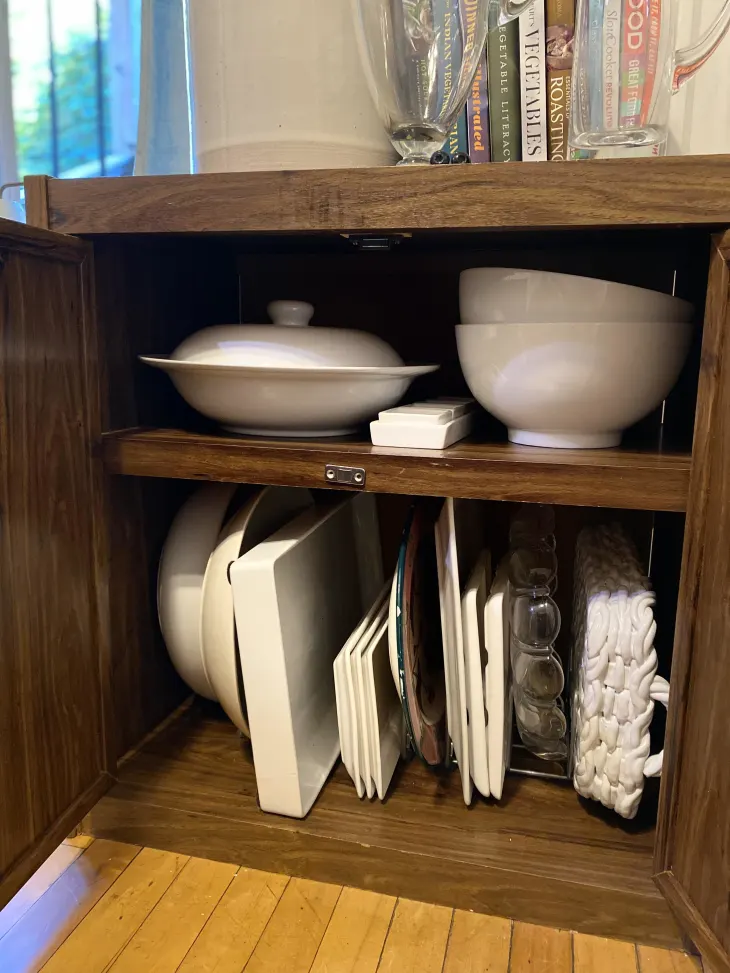
Flat kitchen pieces become awkward the moment they are stacked. Baking sheets slide, cutting boards disappear under heavier items, and large platters often require unloading half a cabinet before they can be reached. Vertical tray storage ideas solve that problem by turning each piece onto its edge and giving frequently used items their own accessible slots.
Why Vertical Storage Works So Well
Vertical storage reduces the amount of lifting required during everyday cooking. Instead of removing three pans to reach the fourth, you can pull the exact baking sheet or board you need.
It also makes better use of narrow cabinets. A cabinet that feels too tight for stacks may work perfectly once dividers create several upright compartments.
Group Similar Shapes Together
Keep baking sheets near cooling racks because their dimensions are usually similar. Cutting boards can occupy another section, while heavier serving platters deserve wider spaces that prevent crowding.
Grouping by shape matters more than arranging everything by color or material. The goal is quick removal without neighboring pieces tipping over.
Choose Dividers That Stay Firm
Permanent wood dividers give built-in cabinetry a finished appearance, while removable wire or metal racks are easier to adjust later. People comparing broader home storage inspiration can still apply the same basic rule: the divider should support the item without creating a slot so tight that removal becomes irritating.
Tall dividers are especially useful for boards and trays that tend to lean. Short dividers may hold small pans but often provide too little support for an oversized platter.
Plan Slot Width Around What You Own
Measure your thickest boards and platters before deciding how many compartments to create. Trying to squeeze seven narrow slots into a cabinet that comfortably supports five usually makes the storage less useful.
Broader interior planning ideas can provide visual inspiration, but actual cookware dimensions should determine the final layout.
| Stored Item | Useful Slot Style | Planning Detail |
|---|---|---|
| Baking sheets | Narrow vertical | Keep similar sizes together |
| Cutting boards | Medium vertical | Allow for thick wood boards |
| Cooling racks | Slim grouped slot | Prevent snagging |
| Platters | Wide supported slot | Avoid pressure on edges |
Adjustable dividers are helpful when your collection changes. A removable system also makes it easier to clean crumbs and dust from the cabinet floor.
Put Vertical Storage Near the Work Zone
Location changes how useful the system feels. Baking sheets belong close to the oven, while cutting boards make more sense near the main preparation counter.
Looking through organized home concepts may inspire different cabinet arrangements, but daily movement should guide placement. Storing trays across the kitchen from where they’re used creates unnecessary steps.
A lower cabinet beside the range is often practical for pans. Large serving platters used only occasionally can occupy a less convenient section.
Where Vertical Tray Storage Can Go Wrong
More dividers don’t automatically create better storage. Extremely narrow compartments can scrape finished trays, trap thick cutting boards, or make heavy platters difficult to grip.
Another mistake is mixing lightweight cooling racks with heavy stone or ceramic pieces in the same loose compartment. The lighter items may shift or bend. Give fragile or heavy pieces enough support, and leave a little finger space so every item can be removed without wrestling with the cabinet.
Frequently Asked Questions
How wide should vertical tray storage slots be?
The right width depends on the actual items being stored. Measure the thickest piece in each group and leave enough extra room for comfortable removal rather than designing every slot to the same dimension.
Can vertical tray dividers be added to an existing cabinet?
Yes. Removable racks, tension-style systems, and fitted divider inserts can work without rebuilding the cabinet. Check the cabinet’s usable interior height and depth before buying or making an insert.
Should heavy platters be stored vertically?
Many can be, provided they have stable support and aren’t pressed tightly against one another. Particularly fragile or unusually heavy serving pieces may be safer in a wider compartment with protective spacing.
Build Storage Around Daily Use
Start with the trays, boards, and platters you reach for most, then create compartments around their real dimensions. A slightly wider, easier-to-use slot is usually better than maximizing the number of dividers. Once every piece has a predictable place, lower cabinets become faster to use and far easier to keep orderly.