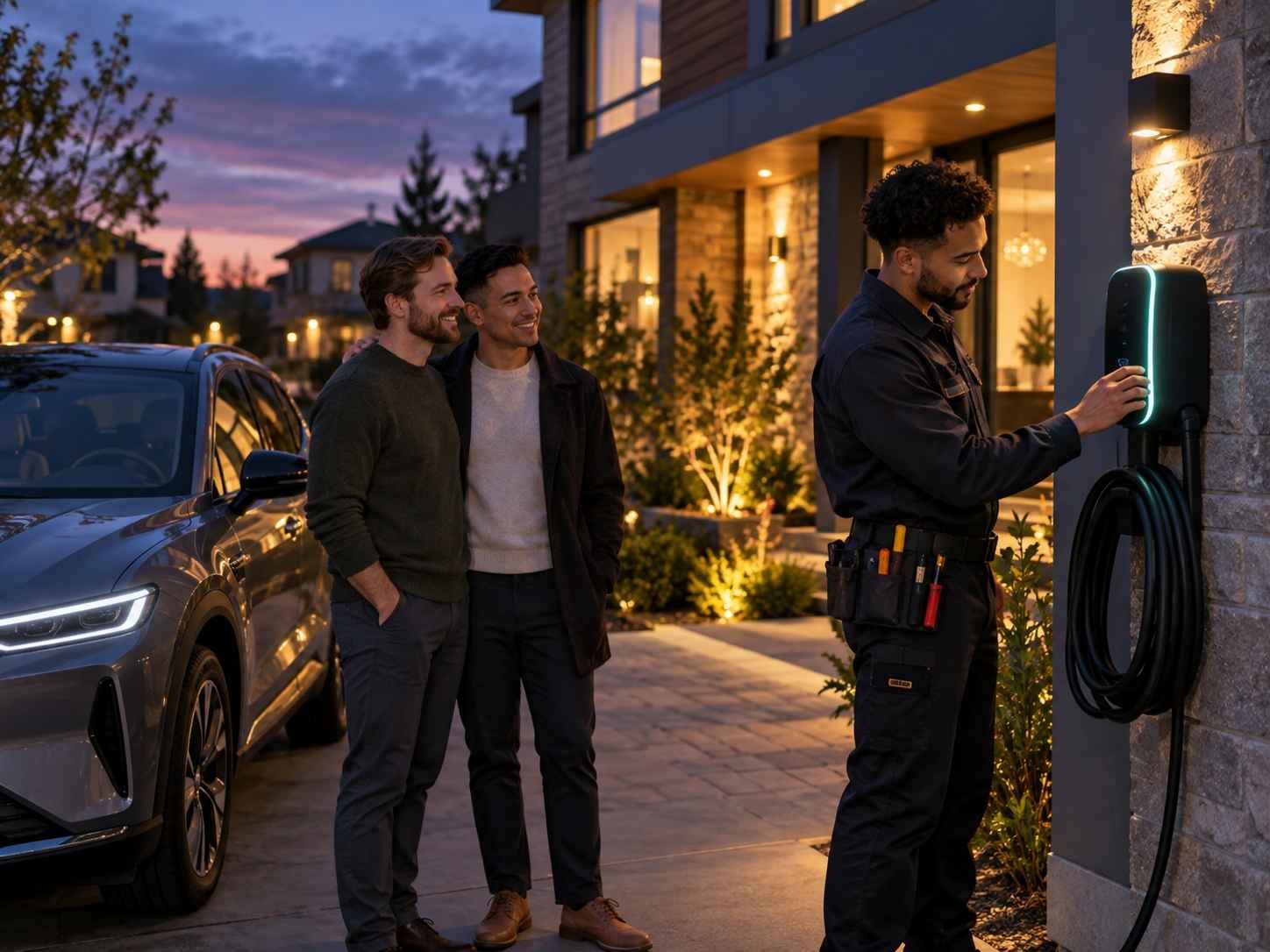
Choosing a home EV charger is only half of the job. The other major decision is figuring out where the charger should actually be installed.
For Vaughan homeowners, charger location can affect convenience, installation complexity, cable reach, weather exposure, future vehicle compatibility and even how easy the charger is to use every day.
If you are planning a Vaughan EV charger installation, it is worth choosing the location carefully before electrical work begins.
The best charger location is not always the closest wall to the electrical panel. It is also not always the spot closest to the vehicle’s current charge port. A good installation should balance electrical practicality with how the driveway or garage is actually used.
Here are the main factors Vaughan homeowners should consider.
Start With Where the Vehicle Usually Parks
The most obvious place to begin is the parking position.
Think about where the EV is normally parked every night.
Is it:
- Inside an attached garage?
- Outside on the driveway?
- In a detached garage?
- On the left side of a two-car garage?
- On the right side?
- Shared between multiple parking spots?
A charger should be positioned so the charging cable reaches the vehicle comfortably without being stretched tight.
If the cable barely reaches the charge port, daily charging quickly becomes frustrating.
The charger should also be located so that the cable does not constantly cross a walkway, garage entrance or other area where people regularly walk.
The ideal installation should feel easy to use without requiring the homeowner to carefully position the vehicle every time.
Consider Where the Charge Port Is Located
Different EV manufacturers place charging ports in different locations.
One vehicle may have the charging port near the driver’s front fender.
Another may have it near the rear taillight.
Some vehicles place it near the front of the car.
This matters because a charger installed perfectly for your current EV may be inconvenient for another vehicle later.
For example, mounting the charger at the very back corner of a garage may work perfectly with a vehicle that has a rear charging port.
If your next EV has its charging port near the front, the same location may require stretching the cable across the vehicle.
When possible, choose a charger position that provides some flexibility.
Think About Your Next EV, Not Just Your Current One
An EV charger may remain installed for many years.
The car that prompted the installation may not.
A homeowner might keep a charger through two or three different vehicles.
That makes future flexibility important.
You do not need to predict exactly which EV you will buy five years from now, but it makes sense to avoid an unnecessarily restrictive installation.
For example, a centrally located charger may be able to serve more than one parking position.
A charger installed between two garage bays may also offer more flexibility than one installed deep in a corner.
The goal is to make the installation useful for the current vehicle without making it unnecessarily difficult for future vehicles.
Distance From the Electrical Panel Matters
From an electrical perspective, the distance between the panel and charger is important.
The charging circuit needs to run from the electrical panel to the charging location.
A shorter and more accessible route is usually simpler than a long route through finished walls, ceilings or other parts of the home.
Longer wiring runs generally require more material and labour.
The path may also need to navigate:
- Finished basements
- Utility rooms
- Drywalled garages
- Exterior walls
- Attics
- Crawlspaces
- Driveways
- Detached structures
That is why charger location should be considered together with the electrical route.
The closest charger location to the parking spot may not always be the easiest electrical installation.
Likewise, the easiest location for the electrician may not be the most convenient location for the homeowner.
A good plan balances both.
Attached Garage Installations Are Often Straightforward
Many Vaughan homes have attached garages.
For these properties, an interior garage wall can often be a practical location for an EV charger.
An attached garage offers several advantages.
The charger is protected from direct rain and snow, and the charging cable can usually be stored more easily.
The charger may also be relatively close to the home’s electrical panel, depending on the layout.
However, not every garage wall is equally suitable.
Before choosing a spot, look at how the garage is actually used.
Avoid locations where the charger may be blocked by:
- Storage shelves
- Bicycles
- Garbage bins
- Workbenches
- Seasonal equipment
- Large tools
A charger that is technically installed in a good electrical location can still be annoying if homeowners have to move storage items every time they want to plug in the vehicle.
Avoid Areas Where the Charger Could Be Hit
Garages are busy spaces.
Vehicles, bicycles, lawn equipment and storage items move around regularly.
The charger should not be mounted where it is likely to be struck by a car door, bumper or other equipment.
This is especially important in tight garages.
Before installation, think about how vehicles enter and exit the space.
Check where doors open.
Look at areas where large items are usually stored.
A slightly different mounting location can reduce the chance of physical damage over the life of the charger.
Think About Cable Storage
EV charging cables are relatively heavy.
If the charger has a permanently attached cable, the cable needs somewhere to go when it is not in use.
Many chargers include a cable holder or connector holster.
The installation location should make it easy to coil the cable neatly.
Poor cable storage can create several problems.
The cable may end up:
- Lying on the garage floor
- Crossing a walkway
- Getting caught under storage items
- Becoming dirty from snow or water
- Creating a tripping hazard
A convenient mounting location makes it easier to keep the charging area organized.
Outdoor Driveway Charging Can Work Well
Not every Vaughan homeowner parks inside a garage.
Some families use the garage for storage and park vehicles on the driveway.
Others have more vehicles than garage spaces.
Outdoor EV charger installation can work well when the equipment and installation are suitable for exterior use.
However, the charger location should be chosen carefully.
The unit should remain accessible throughout the year and should not be placed where it is constantly exposed to avoidable physical damage.
Think about how the driveway is used during different seasons.
Snow Should Be Part of the Planning
Vaughan winters make snow management an important consideration.
A charger that looks perfectly accessible in summer may become inconvenient after a heavy snowfall.
Before mounting an exterior unit, ask where snow usually goes when the driveway is cleared.
Avoid placing the charger directly beside an area where snow is routinely piled.
The same applies to the charging cable.
If the cable regularly lies in snow or slush, charging becomes less convenient.
The charger should remain easy to reach even during winter conditions.
That does not mean outdoor installation is a bad choice.
It simply means the location should be planned for all four seasons.
Avoid Creating a Trip Hazard
The charging cable should not routinely cross a busy walkway.
This is particularly important for outdoor installations where people may walk between the driveway, sidewalk and front entrance.
A charger mounted on the wrong side of the parking space may require the cable to stretch across a path every night.
That creates inconvenience and can increase the chance that someone trips over the cable.
Where possible, the charger should be positioned so the cable reaches the vehicle without crossing common walking routes.
Detached Garages Require Additional Planning
Some Vaughan properties have detached garages.
These installations can be more involved because electricity must reach a structure that is separate from the main house.
Depending on the existing electrical setup, the project may require additional wiring between the house and garage.
The route might involve:
- Underground wiring
- Exterior wiring methods
- Existing garage electrical equipment
- Additional electrical distribution equipment
This makes early planning especially important.
A charger location that seems ideal from inside the garage may create a much more difficult electrical route.
Before finalizing the charger position, an electrician should evaluate how power can practically reach that location.
Two-Car Garages Need More Thought
A two-car garage creates additional possibilities.
If only one household vehicle is electric today, it may be tempting to install the charger specifically for that one parking space.
But what happens if the second vehicle becomes electric later?
A centrally positioned charger may provide more flexibility.
Some homeowners may eventually want two EV chargers.
Others may want one charger that can reach either vehicle depending on parking arrangements.
Thinking about future parking patterns can make the installation more useful long term.
Should the Charger Be Installed Between Two Garage Doors?
In some layouts, installing the charger near the middle of a two-car garage can be convenient.
This can allow one charging cable to reach multiple parking positions.
However, the wall layout and electrical routing must also make sense.
There may be garage door tracks, structural elements or other obstacles in the area.
The charger’s cable length also matters.
The goal is not simply to install the charger in the geometric centre of the garage.
The goal is to find a location that provides convenient access without making the electrical installation unnecessarily complicated.
Smart Chargers Need Connectivity
Many modern EV chargers include Wi-Fi or app-based features.
These may allow homeowners to:
- Schedule charging
- Monitor energy usage
- View charging history
- Change settings
- Receive notifications
- Control charging remotely
If those features matter to you, check the Wi-Fi signal in the proposed installation location.
A charger mounted inside a garage may receive a strong signal.
A charger on the far side of a detached garage may not.
Poor connectivity may limit some of the smart features that influenced the charger purchase in the first place.
It is easier to test the signal before installation than to discover the problem afterward.
Hardwired or Plug-In Can Affect Location
The charger type can also influence placement.
Some EV chargers are hardwired directly into the electrical system.
Others use an appropriate receptacle.
The exact installation requirements depend on the equipment and electrical design.
A homeowner should ideally choose the charger model before the final circuit layout is determined.
That gives the electrician the opportunity to review the manufacturer’s requirements and design the installation accordingly.
Installing the electrical infrastructure first and choosing the charger afterward can sometimes create unnecessary complications.
The Electrical Panel Still Needs Enough Capacity
Even if you find the perfect charger location, the electrical system still needs to support the charger.
The electrician should evaluate the home’s electrical service and panel capacity.
A Level 2 charger can represent a significant electrical load.
Some homes have sufficient available capacity.
Others may require load-management equipment or additional electrical work.
In certain situations, a service upgrade may be considered.
Location and electrical capacity should therefore be planned together rather than treated as completely separate decisions.
Do Not Choose a Location Based Only on Installation Cost
Installation cost matters, but it should not be the only consideration.
The cheapest location may be the wall immediately beside the electrical panel.
But if that location makes the charging cable difficult to reach every day, the homeowner may regret the decision.
An EV charger may be used hundreds of times each year.
Small inconveniences become repetitive quickly.
A slightly longer wiring route may sometimes be worthwhile if it creates a much more practical charging setup.
That decision should be made based on the actual property.
Think About Daily Routine
A useful way to choose the charger location is to imagine the daily charging routine.
You arrive home.
You park the car.
You get out.
You reach for the charging cable.
How many steps does it take?
Does the cable reach easily?
Does it cross another parking space?
Do you have to move anything?
Does the cable lie where someone can trip over it?
Can you return the cable to its holder easily in the morning?
These small details make a major difference over time.
The best charger installation should become part of the daily routine without requiring much thought.
The Best Location Is a Balance
There is no single best EV charger location for every Vaughan home.
The right location depends on the property’s layout and the homeowner’s needs.
A good installation considers:
- Where the EV normally parks
- Charge-port location
- Cable reach
- Future vehicles
- Electrical panel location
- Wiring distance
- Garage layout
- Outdoor weather exposure
- Snow clearing
- Wi-Fi connectivity
- Walking paths
- Potential future EVs
The best result usually comes from considering these factors before electrical work begins.
A charger should not simply be installed on the nearest available wall.
It should be positioned so that the electrical work is practical and charging remains convenient for years.
For Vaughan homeowners, spending a little extra time choosing the location can make a major difference in how useful the charging setup feels every single day.
XBOCT (XB) Electric Inc, (647) 401-7444, 24/7 Licensed Electrical Contractor serving the GTA.